

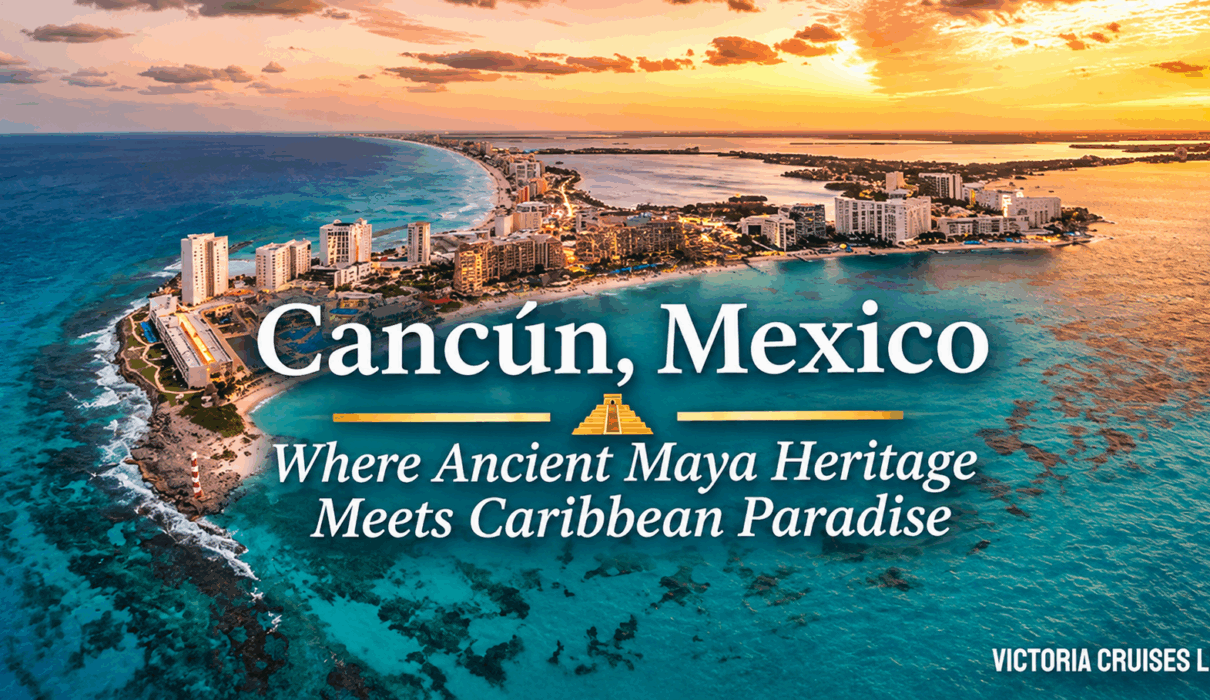
Cancún, Mexico – Where Ancient Maya Heritage Meets Caribbean Paradise
Beyond the turquoise beaches and luxury resorts, discover the ancient Maya civilization, mysterious cenotes, island escapes, and extraordinary flavors of Mexico’s Caribbean coast.
Cancún – More Than a Caribbean Paradise
Some destinations capture the imagination with their beauty. Others fascinate travelers with ancient civilizations, mysterious legends, and remarkable cultural traditions. Cancún offers both. At the northeastern edge of Mexico’s Yucatán Peninsula, brilliant turquoise waters meet powdery white beaches, while the tropical landscape conceals traces of one of the most sophisticated civilizations of the ancient Americas. To many travelers, Cancún is synonymous with luxury resorts, palm-lined beaches, and the warm Caribbean Sea. But beyond its famous coastline lies a much more fascinating story. This is a region where ancient Maya cities once flourished, where underground rivers shaped extraordinary natural formations, and where Indigenous traditions continue to influence everyday life. From magnificent archaeological sites to the flavors of traditional Yucatecan cuisine, Cancún is a gateway to a world that deserves to be explored far beyond the beach.
From Ancient Maya Territory to a Modern Caribbean City
Long before Cancún became an internationally famous vacation destination, the surrounding region was part of the Maya world. The Maya civilization developed complex systems of writing, mathematics, astronomy, architecture, agriculture, and trade across southeastern Mexico and parts of Central America. The coastal settlements of what is now Quintana Roo participated in maritime trade networks that connected communities along the Caribbean shoreline. Canoes transported goods, while fishing, salt production, and regional commerce supported local populations. The archaeological remains scattered throughout the area demonstrate that this coastline was far from an empty wilderness. Yet the modern city of Cancún has a surprisingly recent history. In the late 1960s, Mexican planners identified the area as a potential location for a major tourism development. At the time, the landscape consisted largely of beaches, mangroves, lagoons, and small settlements.
During the 1970s, construction transformed the area into a purpose-built international resort destination. Hotels, roads, an airport, and new residential neighborhoods gradually created the Cancún known today. Within a few decades, it became one of the world’s most recognizable Caribbean vacation destinations. But the story of Cancún did not begin with tourism. Its deeper history belongs to the Maya communities whose cultural legacy remains visible throughout the peninsula.

El Rey – Ancient Maya Ruins in the Heart of Cancún
Many visitors are surprised to discover that they do not need to travel far from Cancún’s Hotel Zone to encounter ancient Maya architecture. El Rey is an archaeological site located along Boulevard Kukulcán, surrounded by the modern resort district. Its surviving structures include ceremonial platforms, plazas, and buildings associated with a settlement that became especially important during the Late Postclassic period. The community was connected to fishing and coastal commerce, activities that supported Maya life along the Caribbean shoreline. Today, the ruins offer a striking contrast between ancient stone structures and the contemporary hotels nearby.
Walking through El Rey provides a fascinating reminder that this landscape was inhabited and culturally significant centuries before modern Cancún existed. It is an excellent starting point for travelers who want to understand the region’s Maya heritage without committing to a full-day excursion.
San Miguelito and the Maya Museum of Cancún
Another remarkable cultural attraction is San Miguelito, an archaeological site located within the grounds of the Museo Maya de Cancún. The museum presents artifacts and historical material associated with Maya civilization, while the surrounding archaeological area preserves structures from an ancient coastal settlement. San Miguelito developed important connections with other communities along the eastern Yucatán coast. Its surviving architecture includes residential and ceremonial structures, revealing aspects of the society that once occupied this area.
Together, the museum and archaeological site provide valuable context for understanding the more famous ruins elsewhere on the peninsula. For visitors staying in Cancún, they offer an accessible introduction to the region’s extraordinary cultural history.
Chichén Itzá – The Extraordinary Legacy of the Maya
Few archaeological sites in the Americas are as recognizable as Chichén Itzá. Located inland in neighboring Yucatán state, this UNESCO World Heritage Site was one of the most influential cities of the ancient Maya world. Its monumental architecture reflects remarkable achievements in engineering, mathematics, astronomy, and religious life. The most famous structure is El Castillo, also known as the Temple of Kukulcán. The stepped pyramid dominates the archaeological complex and is associated with the feathered serpent deity Kukulcán. Around the spring and autumn equinoxes, the interaction of sunlight and shadow along the pyramid’s staircase can create a striking serpent-like visual effect. Other important structures include the Great Ball Court, the Temple of the Warriors, and El Caracol, a building associated with astronomical observation.
Chichén Itzá offers much more than impressive monuments. It reveals the intellectual, political, and ceremonial achievements of a civilization whose descendants continue to preserve Maya languages and cultural traditions today. Because the site is several hours from Cancún by road, it should be planned as a dedicated full-day excursion rather than a short sightseeing stop.

Tip: Tour the fascinating archaeological ruins of Chichén Itzá
Tulum – An Ancient City Above the Caribbean Sea
Among the archaeological sites of the Yucatán Peninsula, Tulum occupies one of the most spectacular locations. Its ancient buildings stand above limestone cliffs overlooking the turquoise Caribbean Sea. The combination of history and coastal scenery makes Tulum one of Mexico’s most photographed archaeological destinations. During the Late Postclassic period, Tulum was an important coastal settlement associated with regional maritime trade. Its defensive walls, ceremonial buildings, and strategic location reflect its significance within the Maya world. One of the best-known structures is El Castillo, positioned dramatically near the cliff edge. The Temple of the Frescoes preserves evidence of the artistic and religious traditions of the settlement. Exploring Tulum offers an opportunity to imagine the arrival of trading canoes along a coastline that once connected Maya communities across the Caribbean.
The archaeological site is located well south of Cancún, so travelers should allow substantial time for transportation and visiting.

Tip: Explore Tulum’s Mayan Pyramid
Cobá – Ancient Roads Through the Jungle
While Tulum is famous for its coastal setting, Cobá reveals a different side of Maya civilization. Surrounded by tropical vegetation, Cobá was once an important inland city connected to other settlements through an extensive network of raised stone roads known as sacbeob. These roads played an important role in communication, movement, and regional connections. The archaeological site contains impressive structures, including the Nohoch Mul pyramid. Its height and surrounding jungle landscape make it one of the most recognizable monuments in the region. Cobá’s atmosphere is very different from the open plazas of Chichén Itzá or the seaside ruins of Tulum.
Here, the ancient buildings emerge from the forest, offering a powerful sense of the relationship between Maya settlements and the natural environment. Access to individual structures, including pyramid climbing, is subject to conservation and visitor regulations and should never be assumed. Cobá is another destination best enjoyed as part of a longer excursion rather than a brief visit from Cancún.
Tip: Let the ancient stones whisper their stories: Coba archaeological site guided
Cenotes – The Sacred Waters of the Maya World
One of the Yucatán Peninsula’s most extraordinary natural features is its network of cenotes. These natural sinkholes form when limestone bedrock collapses or erodes, exposing groundwater beneath the surface. Over thousands of years, water has shaped a remarkable underground landscape of caves, passages, pools, and interconnected systems. Some cenotes are open to the sky, surrounded by tropical vegetation. Others are hidden inside caves, where shafts of sunlight illuminate clear freshwater. Their beauty is extraordinary, but their significance extends far beyond their appearance. For the ancient Maya, water was essential to life, agriculture, and spiritual traditions.
Cenotes were important sources of freshwater in a region with relatively few surface rivers. Some also held ceremonial significance and were associated with sacred beliefs about the natural and supernatural worlds. Today, visitors can swim, snorkel, or dive in selected cenotes, depending on local regulations and conditions. These environments are fragile, however. Visitors should follow site rules, avoid contaminating the water, and respect any restrictions designed to protect the underground ecosystem. A cenote visit can be one of the most memorable experiences in the Yucatán Peninsula. It is an encounter with a natural landscape that has shaped human life in the region for centuries

Tip: Visit two different Cenotes
Isla Mujeres – A Caribbean Island Escape
Just offshore from Cancún lies Isla Mujeres, a small island celebrated for its beautiful beaches and relaxed atmosphere. The island’s name means “Island of Women,” a reference associated with female figures and the Maya goddess Ixchel in historical accounts of the area. Today, Isla Mujeres offers a quieter contrast to Cancún’s busy resort district. Its colorful streets, waterfront restaurants, and inviting beaches make it a popular destination for a day trip.

Tip: Snorkeling at the Underwater Art Museum
Playa Norte
Playa Norte is among the island’s most famous attractions. Its soft white sand and shallow turquoise water create an idyllic Caribbean setting. Visitors can relax by the sea, explore the nearby town, or enjoy the island’s laid-back atmosphere.
Punta Sur
At the southern end of Isla Mujeres, Punta Sur offers dramatic coastal scenery. Rocky cliffs overlook the Caribbean, while sculptures and cultural references add another dimension to the landscape. The area is associated with the worship of Ixchel and the island’s ancient Maya heritage.
A Different Rhythm of Life
One of the pleasures of Isla Mujeres is simply taking time to explore. Small shops, local restaurants, and coastal viewpoints reveal a destination with a character distinct from the mainland. Ferries connect Isla Mujeres with Cancún, although schedules and departure points should be checked before traveling.
MUSA – Art Beneath the Caribbean Sea
One of the region’s most unusual attractions is MUSA, the Museo Subacuático de Arte, or Underwater Museum of Art. This remarkable project features hundreds of sculptures installed beneath the waters around Cancún and Isla Mujeres. The artworks were designed to create an underwater artistic experience while also providing surfaces that marine organisms can colonize over time. The sculptures gradually interact with the surrounding environment as algae, corals, and other organisms settle on their surfaces. Visitors may experience selected installations through snorkeling, diving, or glass-bottom boat excursions, depending on the location and available services. MUSA combines art, marine awareness, and the extraordinary beauty of the Caribbean underwater world. It also encourages reflection on the importance of protecting natural coral reef ecosystems.
The Mesoamerican Reef – A Living Caribbean Treasure
The waters off the Yucatán Peninsula form part of the wider Mesoamerican Reef region, one of the most important coral reef systems in the Western Hemisphere. These marine habitats support an extraordinary variety of fish, corals, sea turtles, and other species. For snorkeling and diving enthusiasts, the region offers opportunities to discover vibrant underwater environments. But coral reefs are also among the world’s most vulnerable ecosystems.
Rising sea temperatures, coral bleaching, pollution, and human activity can place considerable pressure on marine life. Responsible tourism is essential. Visitors should avoid touching corals, maintain a safe distance from wildlife, and follow the instructions of qualified local guides. The Caribbean’s underwater beauty is a natural treasure that deserves careful protection.
The Flavors of Cancún – Discovering Yucatecan Cuisine
Cancún’s food scene is far more diverse than the international restaurants found in its resort district. The culinary traditions of the Yucatán Peninsula reflect centuries of Maya heritage, regional agriculture, and later cultural influences. Corn, achiote, citrus, chiles, seafood, and slow-cooked meats are among the ingredients that give the region its distinctive flavors.
Cochinita Pibil
One of the most celebrated dishes is cochinita pibil. Traditionally, pork is marinated with achiote and sour orange, wrapped in banana leaves, and cooked slowly. The dish is associated with cooking traditions that developed from Maya techniques and later adaptations. Its tender texture and rich, aromatic flavor make it an essential part of Yucatecan cuisine.
Sopa de Lima
Sopa de lima is a fragrant regional soup prepared with poultry, vegetables, spices, and the distinctive citrus flavor of Yucatecan lime. Often served with crispy tortilla strips, it offers a refreshing combination of comforting and bright flavors.
Panuchos
Panuchos are another popular specialty. These fried corn tortillas are traditionally filled with refried beans and topped with ingredients such as shredded turkey or chicken, lettuce, pickled onions, and avocado. They are a wonderful example of the region’s street-food culture.
Tikin Xic
Seafood lovers should look for tikin xic, a traditional fish preparation associated with the Yucatán coast. The fish is typically seasoned with achiote and citrus, wrapped or cooked with banana leaves, and grilled or roasted. Its flavors reflect the region’s strong connection to the sea.
Marquesitas
For dessert, try a marquesita, a crispy rolled wafer sold by street vendors. One traditional filling combines Edam cheese with sweet ingredients, creating an unusual but delicious balance of flavors. Modern variations may include chocolate-hazelnut spread, fruit, or other fillings. The aroma of freshly prepared marquesitas is a familiar part of evening street life in many Yucatán Peninsula destinations.
Fresh Caribbean Seafood
Cancún also offers a wide variety of seafood dishes, including ceviche prepared with fish or shrimp, citrus, onions, tomatoes, and herbs. Together, these specialties reveal a culinary identity that extends far beyond familiar international Mexican dishes.
Beyond the Resorts – Discovering Everyday Cancún
Although the Hotel Zone is Cancún’s best-known area, the city’s downtown neighborhoods offer a different atmosphere. Here, local restaurants, markets, public spaces, and everyday businesses reveal the life of a modern Mexican city. Visitors interested in experiencing Cancún beyond its resort image can explore established public markets, sample regional dishes, and discover local crafts. Parque de las Palapas is one of the city’s familiar gathering places, associated with casual food stalls and community life. The contrast between downtown Cancún and the Hotel Zone illustrates how the destination has developed into much more than a collection of beachfront hotels. For travelers interested in culture, spending time outside the resort district can provide a more complete understanding of the city.
Exploring Cancún and the Riviera Maya
Cancún offers a remarkable range of experiences, but careful planning is essential. The region’s attractions are spread across a large geographical area. El Rey, the Maya Museum, and San Miguelito are located within Cancún’s Hotel Zone and are among the more accessible cultural attractions for visitors already staying in the city. Isla Mujeres requires a ferry crossing and is best enjoyed with sufficient time to explore the island. Chichén Itzá, Tulum, and Cobá are considerably farther away and generally require dedicated excursions.
Cenotes are scattered throughout the peninsula, so travel times vary significantly depending on the chosen location. For cruise travelers, one important distinction must be understood: Cancún is not a conventional deepwater cruise port for large ocean-going ships. Cruise vessels visiting the wider region commonly use ports such as Cozumel or Costa Maya.
A visit to Cancún from another port may involve substantial transportation and should be planned according to the ship’s itinerary and available time. Travelers should also consider seasonal heat, tropical weather, and the possibility of strong sun exposure. Comfortable footwear, drinking water, appropriate sun protection, and respect for archaeological and environmental regulations will make the experience more enjoyable. The best way to discover Cancún is not to rush through every famous attraction. It is to choose experiences that allow enough time to appreciate the history, landscape, and culture behind them.
Cancún – Where Two Worlds Meet
Cancún is often described as a Caribbean paradise, and its spectacular coastline certainly deserves that reputation. But the region’s true appeal lies in the remarkable combination of natural beauty and cultural history. Ancient Maya cities reveal the achievements of a civilization whose influence continues today.
Cenotes connect visitors with the geological and spiritual history of the Yucatán Peninsula. Isla Mujeres offers a quieter island atmosphere, while the surrounding reefs reveal an extraordinary underwater world. And the flavors of traditional Yucatecan cuisine tell stories of Indigenous knowledge, local ingredients, and generations of culinary traditions. From the ancient stones of El Rey to the turquoise waters of the Caribbean, Cancún invites travelers to look beyond the familiar image of luxury resorts.
At Victoria Cruises Line, we believe that the most rewarding journeys are those that reveal the history, culture, and people behind each destination. Cancún is one of those places. A meeting point between ancient Maya heritage and modern Caribbean life, where every journey offers another story waiting to be discovered.
Continue exploring extraordinary destinations and authentic cultural experiences with Victoria Cruises Line.