

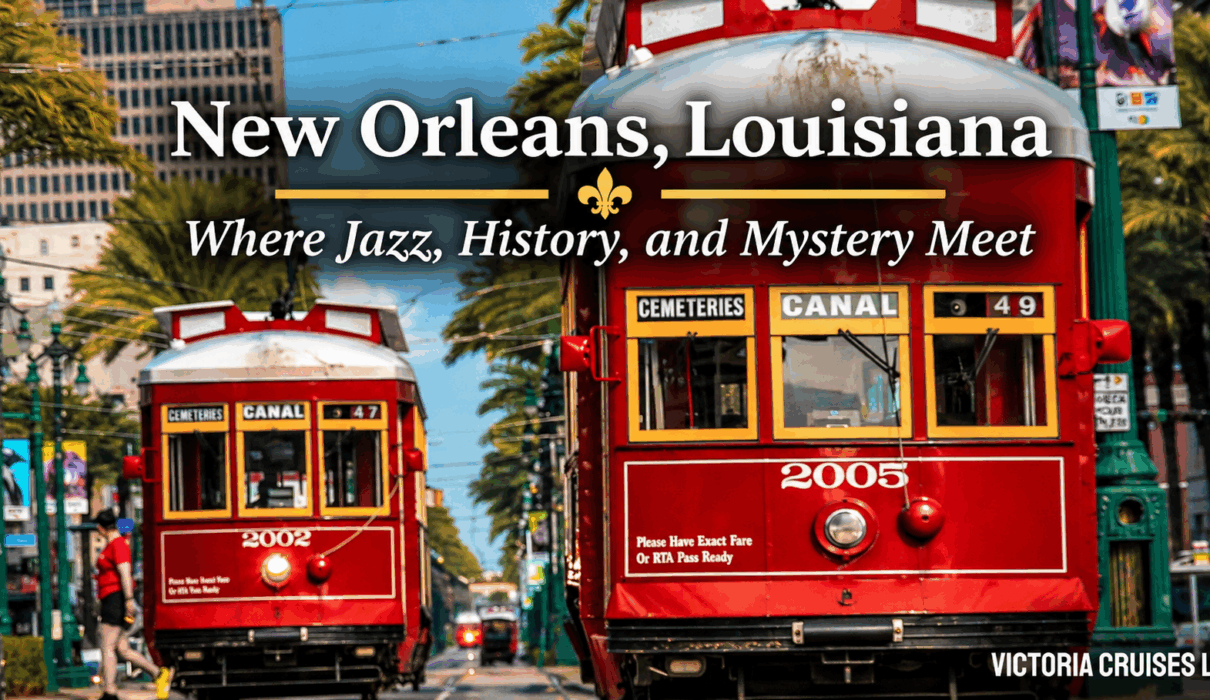
Discover the soul of New Orleans, from the birthplace of jazz and the colorful French Quarter to Creole cuisine, Mardi Gras traditions, and the mysterious heritage of the Mississippi.
New Orleans – A City Unlike Any Other
Some cities are remembered for their architecture. Others are celebrated for their music, food, or fascinating history. New Orleans has all of these, wrapped in an atmosphere that is impossible to confuse with anywhere else in America. Imagine the sound of a trumpet drifting through a narrow street, the aroma of freshly prepared beignets filling the morning air, and the graceful iron balconies of centuries-old buildings overlooking lively cafés. Nearby, the Mississippi River flows past a city that has welcomed merchants, musicians, immigrants, and travelers for more than three centuries.
Welcome to New Orleans.

Located in southeastern Louisiana, near the Gulf of Mexico, New Orleans is one of the most culturally distinctive cities in the United States. Its character was shaped by French and Spanish colonial rule, African and Caribbean influences, Native American traditions, and generations of immigrants who brought their languages, customs, and culinary knowledge to the Mississippi Delta.
This extraordinary cultural mixture gave the world jazz, unforgettable Creole cuisine, colorful Mardi Gras celebrations, and a rich collection of legends. But New Orleans is much more than its famous festivals and mysterious stories. It is a city of resilience, creativity, and living traditions, where history can be experienced around almost every corner.
A City Born Beside the Mississippi
New Orleans was founded in 1718 by the French Mississippi Company under the direction of Jean-Baptiste Le Moyne de Bienville. Its location was carefully chosen. The Mississippi River provided an essential connection between the Gulf of Mexico and the vast interior of North America. Long before European colonization, Indigenous peoples had lived and traveled throughout the region, using its waterways for transportation, fishing, and trade. The area became part of French Louisiana, a colonial territory whose economic importance grew alongside maritime commerce.
In 1763, following agreements reached during the Seven Years’ War, New Orleans passed into Spanish control. Although the city returned briefly to French sovereignty in 1803, it became part of the United States later that year through the Louisiana Purchase. The transaction dramatically expanded American territory and transformed the political future of the Mississippi Valley. Throughout the nineteenth century, New Orleans developed into one of the country’s most important ports.
Cotton, sugar, and other commodities moved through its busy waterfront. Yet the city’s prosperity was also inseparable from slavery and the forced labor of enslaved Africans and African Americans. New Orleans became a major center of the domestic slave trade, while free people of color also formed an important part of the city’s social and cultural life. The experiences, resistance, knowledge, and creativity of Black communities profoundly shaped the New Orleans we recognize today. Its music, food, language, and cultural traditions cannot be understood without acknowledging this history.
The French Quarter – Where History Lives on Every Street
The French Quarter, also known as the Vieux Carré, is the historic heart of New Orleans. Despite its name, much of the architecture visitors admire today reflects Spanish colonial influence and rebuilding after devastating fires in 1788 and 1794. Colorful facades, hidden courtyards, decorative iron balconies, and narrow streets create an atmosphere unlike that of most American cities. Walking through the French Quarter feels like entering a place where several centuries of history exist side by side.

Jackson Square and St. Louis Cathedral
Jackson Square is one of the city’s most recognizable landmarks. At its center stands a public square surrounded by historic buildings, with the magnificent St. Louis Cathedral rising above the scene. The cathedral is among the most famous religious landmarks in Louisiana and remains an important symbol of New Orleans. Nearby, the Cabildo and the Presbytère preserve important chapters of Louisiana’s history through museum exhibitions. Street artists, musicians, and visitors contribute to the lively atmosphere around the square. It is an excellent place to begin exploring the city.
Royal Street – Art, Architecture, and Elegance
Just a short walk away, Royal Street offers a different side of the French Quarter. Known for its galleries, antique shops, historic buildings, and elegant storefronts, the street provides a quieter alternative to the nightlife of Bourbon Street. Its architectural details reward visitors who take time to look above the shop windows. Decorative balconies, colorful shutters, and hidden courtyards reveal the distinctive character of historic New Orleans.
Bourbon Street – The City’s Famous Nightlife
Bourbon Street is internationally known for its bars, entertainment venues, and lively nightlife. It is undoubtedly part of the New Orleans experience, but it represents only one aspect of the city’s cultural identity. For travelers interested in authentic music, architecture, and history, the surrounding streets often reveal a more varied and rewarding experience.
The Birthplace of Jazz – Music That Changed the World
Few cities have influenced global music as profoundly as New Orleans. Around the turn of the twentieth century, musicians in the city developed musical traditions that helped give rise to jazz. The genre emerged through the interaction of African American musical practices, blues, ragtime, brass-band traditions, spirituals, and other influences. Improvisation, syncopation, and collective musical expression became defining characteristics of the developing style. New Orleans provided the environment in which these traditions could meet and evolve.
Louis Armstrong – A Musical Legend
One of the city’s most celebrated sons was Louis Armstrong, born in New Orleans in 1901. Armstrong became one of the most influential musicians in jazz history. His remarkable trumpet playing, improvisational creativity, and distinctive singing style transformed the development of popular music. Although his career eventually took him far beyond Louisiana, his musical roots remained deeply connected to New Orleans. Today, his legacy is celebrated throughout the city.
Congo Square – A Place of Cultural Memory
Located within Louis Armstrong Park, Congo Square holds exceptional historical importance. During the colonial and early American periods, enslaved and free people of African descent gathered in this area at various times to socialize, trade, dance, and make music. These gatherings helped preserve and transform African-derived musical and cultural practices. Congo Square is often discussed as an important part of the broader cultural history that contributed to the development of New Orleans music. Its significance extends far beyond jazz alone. It is a place of remembrance, creativity, and African American cultural heritage.
Tremé – One of America’s Historic Black Neighborhoods
The Tremé neighborhood is closely associated with New Orleans’s African American and Creole history. Its cultural traditions include brass bands, second-line parades, social aid and pleasure clubs, and generations of musicians. Exploring Tremé offers a deeper understanding of the communities that helped shape the city’s artistic identity.
Preservation Hall and Frenchmen Street
For visitors hoping to experience live jazz, Preservation Hall is one of the city’s best-known traditional music venues. Its intimate performances celebrate the musical heritage of New Orleans. Frenchmen Street, especially in the Faubourg Marigny neighborhood, is another popular destination for live music. Jazz, blues, funk, and contemporary styles can often be heard in its clubs and performance spaces. New Orleans is not simply a city where jazz was born. It is a place where music remains part of everyday life.
The Historic Streetcars – Traveling Through New Orleans History
One of the most charming ways to discover New Orleans is aboard its historic streetcars. The city’s streetcar network is both a practical transportation system and an important part of its cultural identity. The St. Charles Avenue line is especially famous for its traditional green streetcars. Traveling along the avenue, passengers pass beneath magnificent oak trees and through neighborhoods filled with historic residences. The Canal Street line, recognizable by its red streetcars, connects downtown with other parts of the city. For visitors, these streetcars offer an opportunity to experience New Orleans at a slower pace. The journey itself becomes part of the attraction. The rhythmic movement of the streetcar, the passing architecture, and the changing neighborhoods reveal a city whose history is still visible in its streets.
The Garden District – Southern Elegance and Historic Mansions
Beyond the French Quarter, the Garden District presents another fascinating architectural landscape. Developed largely during the nineteenth century, the neighborhood is known for its elegant mansions, landscaped gardens, decorative iron fences, and magnificent oak trees. Its buildings reflect the prosperity and architectural ambitions of wealthy residents during the antebellum and postbellum periods. Greek Revival and Italianate influences can be seen throughout the district. A walk along its residential streets offers a quieter experience than the busy French Quarter. Visitors should remember that many of these beautiful buildings remain private homes. The Garden District is best appreciated through respectful walking tours and admiration of the architecture from public streets.
Mardi Gras – The Celebration That Defines New Orleans
Few celebrations are as closely associated with a city as Mardi Gras is with New Orleans. The festival season culminates on Fat Tuesday, the day before Ash Wednesday in the Christian calendar. Its history reflects French Catholic traditions, but the modern celebration has developed into a distinctive expression of New Orleans culture. Colorful parades, elaborate costumes, music, and decorated floats fill the city during Carnival season.
The Krewes of New Orleans
Mardi Gras parades are organized by social organizations known as krewes. These groups plan themed floats, costumes, and festivities, often following traditions that have developed over generations. During parades, participants toss small gifts known as throws to spectators. Beads, decorated cups, and other souvenirs have become familiar symbols of Carnival.
The Colors of Mardi Gras
Purple, green, and gold are traditionally associated with New Orleans Mardi Gras. They are commonly interpreted as representing justice, faith, and power. These colors appear throughout the city during the Carnival season.
Black Masking Indians – An Extraordinary Cultural Tradition
One of New Orleans’s most remarkable Carnival traditions is associated with communities historically known as Mardi Gras Indians, also increasingly referred to as Black Masking Indians. Participants create extraordinary handmade suits decorated with beads, feathers, and intricate designs. These traditions reflect African American cultural expression, community identity, and complex historical relationships with Native American heritage. The suits often require months of work and extraordinary artistic skill. They represent far more than festival costumes. They are works of art and expressions of living cultural traditions.
Louisiana Voodoo – Faith, History, and the City’s Mysterious Reputation
New Orleans is famous for its mysterious atmosphere. Stories of spirits, rituals, haunted houses, and supernatural encounters have long attracted visitors.
But behind the city’s reputation for magic lies a serious and fascinating religious history. Louisiana Voodoo developed through the interaction of West and Central African spiritual traditions, Catholicism, and the experiences of African-descended communities in colonial Louisiana. Its practices evolved under the difficult conditions of slavery, cultural displacement, and religious adaptation. Voodoo should not be confused with the sensationalized images often presented in horror films or tourist entertainment. For practitioners, it has been connected to spirituality, healing, community, and relationships with the sacred.
Marie Laveau – The Voodoo Queen of New Orleans
One of the most famous figures associated with Louisiana Voodoo is Marie Laveau. Born in the early nineteenth century, Laveau became widely known as a spiritual practitioner and influential figure in New Orleans. Historical accounts of her life are mixed with legends that developed over generations. She is associated with healing, religious practices, and the complex social world of nineteenth-century New Orleans. Her reputation eventually made her one of the city’s most recognizable historical personalities. Today, stories about Marie Laveau continue to contribute to New Orleans’s mysterious cultural identity. Visitors interested in the subject should seek historical interpretation that distinguishes documented facts from folklore.
The Cities of the Dead – New Orleans’s Historic Cemeteries
New Orleans’s cemeteries are among its most unusual landmarks. Because of the city’s low elevation, high groundwater conditions, and burial traditions, above-ground tombs became a prominent feature of many historic cemeteries. Rows of elaborate family tombs, mausoleums, and stone monuments create landscapes that have earned the nickname “Cities of the Dead.”
St. Louis Cemetery No. 1
Established in the late eighteenth century, St. Louis Cemetery No. 1 is among the city’s oldest surviving cemeteries. It is associated with many notable historical figures, including Marie Laveau, who is traditionally believed to be buried there. Access is regulated, and visitors should check current authorized tour arrangements. Other historic cemeteries have different visiting rules. These places deserve respect as burial grounds and sites of cultural memory, rather than simply as settings for ghost stories.
The New Orleans Pharmacy Museum – Medicine, History, and Curiosity
Located in the French Quarter, the New Orleans Pharmacy Museum offers another fascinating glimpse into the city’s past. The museum occupies a historic building associated with early nineteenth-century pharmacy practice. Its exhibitions explore the history of medicine, pharmaceutical preparations, and healthcare. Historic bottles, medical instruments, and pharmaceutical equipment illustrate how treatments and professional practices have changed over time. The museum also provides an interesting perspective on the relationship between scientific medicine, traditional remedies, and the beliefs of earlier generations. For visitors interested in unusual museums, it is one of the French Quarter’s distinctive cultural attractions.
The Mississippi River – The Lifeblood of New Orleans
New Orleans would not exist in its present form without the Mississippi River. For centuries, the river has connected the agricultural and industrial regions of North America with international maritime trade. Its importance helped transform New Orleans into one of the country’s great port cities. Today, commercial vessels, barges, and riverboats continue to travel along its waters. The riverfront provides visitors with a powerful reminder of the city’s maritime identity
Tip: New Orleans: French Quarter walking tour with tasting

Steamboats and Riverboat Traditions
During the nineteenth century, steamboats became symbols of Mississippi River commerce and transportation. Their paddle wheels and distinctive silhouettes remain closely associated with the romantic imagery of the American South. Modern sightseeing riverboats preserve aspects of this tradition, offering visitors a chance to experience the river from the water. A river cruise can provide a different perspective on the skyline, historic waterfront, and working port.
The Moon Walk and Riverfront
Near Jackson Square, the riverfront promenade known as the Moon Walk offers views of the Mississippi. It is an excellent place to watch the river traffic and appreciate the relationship between New Orleans and the waterway that shaped its history.

Creole and Cajun Cuisine – The Flavors of Louisiana
New Orleans is one of America’s great culinary destinations. Its cuisine reflects centuries of cultural exchange among African, French, Spanish, Native American, Caribbean, and other communities. Two traditions are especially associated with Louisiana: Creole and Cajun cooking. Although they share ingredients and influences, their histories are not identical. Creole cuisine developed through the diverse cultural environment of New Orleans and colonial Louisiana. Cajun cooking is associated with the Acadian communities who settled in Louisiana after their displacement from parts of present-day Canada. Over time, these traditions influenced one another and became central to Louisiana’s culinary identity.
Gumbo – A Bowl of Louisiana History
Gumbo is one of the region’s most celebrated dishes. It is a rich soup or stew that may include seafood, chicken, sausage, vegetables, and a deeply flavored broth. Many versions use a roux, while others may incorporate okra or filé powder as thickening ingredients. Its ingredients and preparation methods reflect the diverse cultural influences that shaped Louisiana cooking. Gumbo is not simply a meal. It is a culinary expression of the region’s history.
Jambalaya – A Louisiana Classic
Jambalaya is a flavorful rice dish prepared with combinations of meat, seafood, vegetables, and seasonings. Recipes vary considerably across Louisiana. Some versions include tomatoes, while others do not. The dish is often associated with the region’s blending of European, African, and local culinary traditions.
Po’boy – The Famous New Orleans Sandwich
The po’boy is one of New Orleans’s most recognizable foods. Traditionally served on French-style bread, it may be filled with fried shrimp, oysters, roast beef, or other ingredients. A widely repeated origin story connects the name to the 1929 streetcar workers’ strike and the Martin brothers, who operated a local restaurant. Although the precise history is more complex than the popular legend suggests, the sandwich remains an essential part of the city’s food culture.
Crawfish Étouffée
Étouffée is a Louisiana specialty featuring seafood, often crawfish or shrimp, served in a rich, seasoned sauce over rice. Its name comes from the French word meaning “smothered.” The dish is particularly associated with Louisiana’s Cajun and Creole culinary traditions.
Beignets and Café au Lait
For many visitors, the perfect New Orleans morning begins with beignets and coffee. Beignets are square pieces of fried dough generously covered with powdered sugar. They are traditionally enjoyed with café au lait, often prepared in the New Orleans style using coffee blended with chicory. The famous Café du Monde near Jackson Square is one of the city’s best-known destinations for this classic combination.
King Cake – A Carnival Tradition
During Mardi Gras season, king cake becomes a familiar sight in bakeries and homes. The sweet pastry is often decorated with purple, green, and gold sugar. A small figurine or token is traditionally associated with the cake, and local customs vary regarding the person who receives it. King cake connects New Orleans’s culinary culture with the festive traditions of Carnival.

Tip: the most popular Pub tours:
Extra tip for the passengers of the Victoria Residential ship: the ship’s deck music in the Neptun Lounge, the Mix and the Ocean bar, order one of these cocktails to your liking
Hurricane Katrina – Tragedy, Resilience, and Renewal
No account of modern New Orleans would be complete without acknowledging Hurricane Katrina. In August 2005, Katrina struck the Gulf Coast and caused catastrophic flooding in New Orleans after failures in the city’s levee and floodwall system. Large parts of the city were submerged. Thousands of residents were displaced, neighborhoods suffered extensive damage, and the disaster caused enormous loss of life across the affected region.
Katrina exposed serious weaknesses in infrastructure, emergency preparedness, and social inequality. Its effects were particularly devastating for many low-income and African American communities. The years that followed brought difficult questions about rebuilding, housing, displacement, and the preservation of local culture.
New Orleans has made significant progress in rebuilding, but the consequences of Katrina remain part of the city’s social and historical landscape. The disaster also revealed the determination of residents, musicians, artists, neighborhood organizations, and cultural institutions to preserve the city’s identity.
New Orleans’s recovery is not simply a story of buildings reconstructed. It is a continuing story about community, belonging, and the importance of cultural heritage.
Discovering New Orleans During a Cruise Port Visit
New Orleans is an especially rewarding destination for travelers arriving by ship. The cruise terminals are located along the Mississippi River, relatively close to the city’s historic districts, although distances vary according to the terminal. For visitors with limited time, the French Quarter is an excellent starting point. Begin with Jackson Square and St. Louis Cathedral, then explore the historic streets and architecture of the Vieux Carré. A stop for beignets and café au lait provides a delicious introduction to the city’s culinary traditions.
Continue along Royal Street, where galleries, antique shops, and historic buildings reveal another side of New Orleans. Travelers interested in music may wish to explore venues associated with traditional jazz or learn more about the history of Congo Square and Tremé. The riverfront offers a chance to appreciate the Mississippi’s importance to the city. For those with additional time, a ride aboard a historic streetcar provides a memorable way to experience the surrounding neighborhoods.
The Garden District, museums, and other attractions may require more transportation and should be planned according to the ship’s schedule. New Orleans is a city that rewards curiosity. Even a short visit can offer an extraordinary combination of history, architecture, music, and food.

Tip: You can book the tours here Pharmacymuseum
VNew Orleans – Where Every Street Has a Story
New Orleans is not a city that can be understood through a single landmark or attraction. Its identity was created through centuries of cultural encounters, conflict, creativity, and resilience. The French Quarter preserves the architectural legacy of its colonial past. The sounds of jazz recall the musical innovations of African American communities.
Mardi Gras celebrates traditions that continue to evolve with each generation. Its historic cemeteries and spiritual heritage contribute to an atmosphere unlike anywhere else in the United States. And the Mississippi River remains a constant presence, connecting the city to the wider world.
From the elegance of Royal Street to the rhythm of a jazz trumpet, from the aromas of Creole cooking to the gentle movement of a historic streetcar, New Orleans offers experiences that remain in the memory long after a journey ends. At Victoria Cruises Line, we believe that the most remarkable destinations are those whose stories continue to unfold. New Orleans is one of those places. A city of jazz, history, mystery, and extraordinary cultural richness.
Discover more fascinating destinations and travel stories with Victoria Cruises Line.