

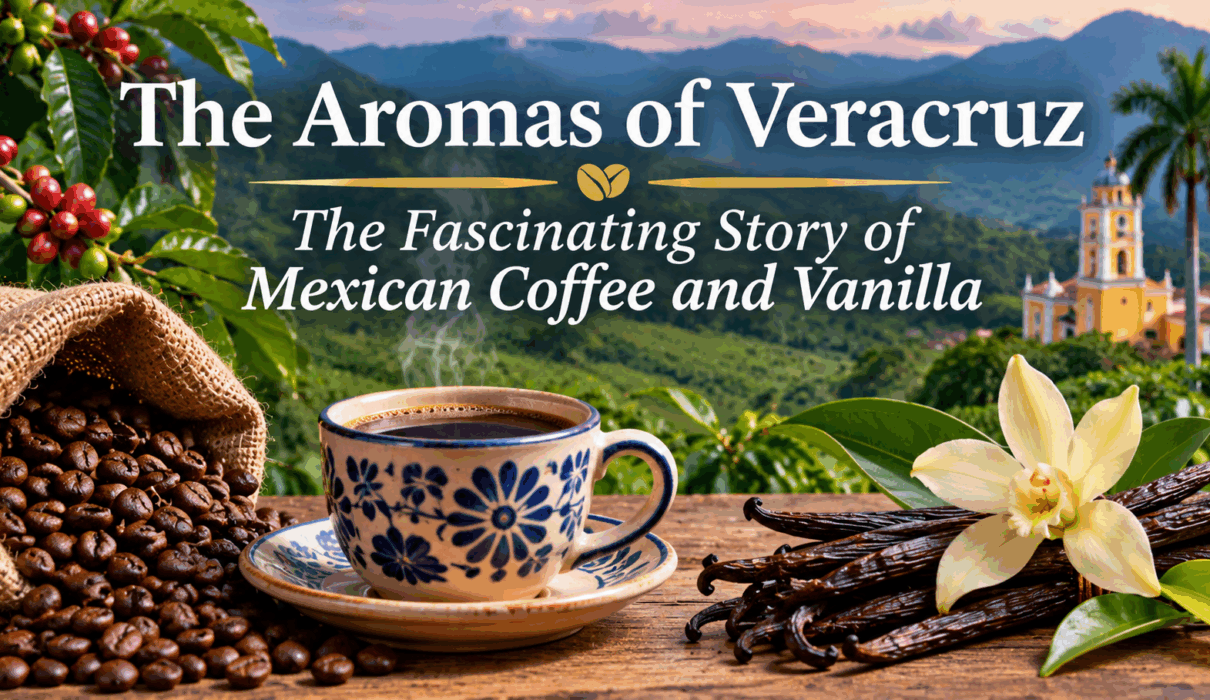
From the misty coffee plantations of Coatepec to the fragrant vanilla orchids of Papantla, discover two extraordinary treasures of Mexico’s Gulf Coast.
Two Extraordinary Aromas, One Remarkable Region
Some destinations stay in our memories because of their spectacular landscapes. Others leave a lasting impression through their history, architecture, or people.
Veracruz, on Mexico’s Gulf Coast, has another way of captivating travelers: through its aromas. Imagine walking along a quiet street in a mountain town, where freshly roasted coffee fills the air. Beyond the colorful buildings, lush plantations cover the hillsides, their coffee plants growing beneath the shade of tropical trees. Farther north, in the warm, humid landscapes surrounding Papantla, another extraordinary plant grows among the vegetation.
Its delicate flowers belong to an orchid whose fruit produces one of the world’s most recognizable flavors: vanilla.
Coffee and vanilla may seem like very different products, but in Veracruz, they share a remarkable connection. Both are deeply rooted in the region’s agricultural traditions, both require patience and craftsmanship, and both tell stories about the people who have cultivated them for generations. To discover their origins is to explore a fascinating side of Mexico that extends far beyond its famous beaches and historic cities.

Coatepec – The Coffee Capital of Veracruz
Nestled in the green mountains near Xalapa, Coatepec is one of Mexico’s most charming coffee towns. Its name comes from Nahuatl and is commonly interpreted as “Hill of Snakes.” Today, Coatepec is celebrated for its coffee-growing heritage, traditional architecture, and lush surroundings. The town’s historic center invites visitors to wander along picturesque streets, admire colonial-style buildings, and relax in welcoming cafés.
Orchids, gardens, and tropical vegetation add to its distinctive atmosphere. But Coatepec’s real treasure lies in the surrounding countryside. Here, the combination of elevation, rainfall, fertile soil, and mild temperatures creates favorable conditions for growing Arabica coffee. Coffee plantations spread across the hills, often beneath the shade of taller trees.
The resulting landscape is not only beautiful but also closely connected to the region’s economic and cultural identity. For generations, coffee cultivation has shaped local communities, family traditions, and everyday life.
How Coffee Became Part of Veracruz’s Identity
Coffee originated far from Mexico, with its early history associated with northeastern Africa and the Arabian Peninsula. As coffee consumption spread around the world, the plant eventually reached the Americas. Coffee cultivation developed in Mexico during the colonial period and expanded in subsequent centuries.
Veracruz became one of the country’s important coffee-producing regions, thanks in part to the suitable growing conditions found in its mountainous interior.
Over time, coffee became more than an agricultural commodity. It influenced the architecture of rural estates, the development of processing facilities, local trade, and the social traditions of towns such as Coatepec. Today, coffee remains an important part of the region’s identity. A visit to Veracruz’s coffee country offers an opportunity to discover the journey from a small tropical fruit to the aromatic beverage enjoyed around the world.
From Coffee Cherry to Coffee Cup
Coffee production involves far more than simply harvesting beans. The process begins with the coffee plant, which produces small fruits known as coffee cherries. When ripe, these cherries are typically red or yellow, depending on the variety. Inside each fruit are the seeds that eventually become coffee beans.
Harvesting
On many farms, ripe cherries are picked by hand. Selective harvesting allows workers to choose fruit at the appropriate stage of maturity, although methods vary according to the farm and its production system..

Processing
After harvesting, the coffee must be processed to remove the fruit and prepare the seeds for drying. One traditional approach is washed processing, in which the outer fruit is removed and the remaining material is processed before drying. Other methods, including natural and honey processing, can create different flavor characteristics.
Drying and Roasting
The processed coffee is dried to an appropriate moisture level before storage and further preparation. Roasting then transforms the green coffee beans, developing the aromas and flavors associated with the finished beverage. The roasting process can highlight different characteristics, from floral and fruity notes to chocolate, caramel, and roasted-nut flavors. Understanding these stages makes a cup of coffee much more interesting. Every sip represents months of agricultural work, careful processing, and decisions made by farmers and roasters.
Discovering Coatepec’s Coffee Haciendas
One of the most rewarding ways to explore Coatepec is by discovering its historic coffee estates and cultural attractions. The original coffee route includes several places associated with the region’s agricultural past.

Tip: Full-day coffee tour
Xalapa, Xico & Coatepec Culture and Coffee Tour
Finca Roma and the Bola de Oro Coffee Museum
The Bola de Oro coffee tradition is closely connected with Coatepec’s coffee heritage. The museum experience associated with Finca Roma introduces visitors to the history of coffee cultivation and processing. Historic equipment, including machinery used to remove the outer fruit from coffee cherries, illustrates how coffee production developed over time. For travelers interested in food history, these details reveal the work behind a product often taken for granted. Museum access and guided visits should be confirmed before traveling.
Hacienda de la Orduña
Hacienda de la Orduña is another important landmark associated with Coatepec’s historical landscape. The former estate has served cultural purposes, reflecting the region’s connection between agricultural history, architecture, and the arts. Its setting provides an opportunity to appreciate the atmosphere of traditional Mexican haciendas.
Hacienda Zimpizahua
Hacienda Zimpizahua is known for its historic estate surroundings and hospitality activities. Its architecture and gardens reflect the rural heritage of the Coatepec area. Visitors interested in historic accommodation and regional cuisine may find it a worthwhile stop, subject to current access arrangements.
El Trianon Hacienda
El Trianon is another property associated with the area’s hacienda heritage. The original travel account highlights its preserved furnishings and wrought-iron details, offering a glimpse of the architectural traditions of an earlier era. Because individual properties may operate privately or change their visitor arrangements, it is advisable to confirm access in advance. Together, these destinations reveal that coffee tourism in Veracruz is not simply about tasting a beverage. It is about discovering a landscape shaped by farming, architecture, family businesses, and local traditions.
Papantla – The Historic Homeland of Mexican Vanilla
Travel north through Veracruz state, and another fascinating agricultural story begins. The region surrounding Papantla is closely associated with the history of vanilla cultivation. Here, warm temperatures, humidity, and tropical vegetation provide conditions suitable for growing vanilla orchids. But the significance of Papantla goes far beyond agriculture. The area is part of Totonacapan, the traditional homeland of the Totonac people, whose cultural heritage has played a fundamental role in the history of vanilla. Long before vanilla became a familiar ingredient in desserts around the world, Indigenous communities in Mesoamerica knew and valued its distinctive aroma.

Vanilla was used in connection with food, beverages, trade, and cultural traditions. The Totonac people developed important knowledge about the plant and its cultivation. Over time, vanilla became one of the region’s most valuable agricultural products, eventually reaching markets far beyond Mexico. Today, Papantla remains an essential destination for understanding the cultural origins of this extraordinary spice.
The Totonac Legend of Vanilla
One of the most beautiful aspects of vanilla’s cultural history is its connection to traditional storytelling. A Totonac legend tells of a young woman and a forbidden love, whose tragic story becomes associated with the appearance of the vanilla orchid. Different versions of the legend have been passed down over time. Although it is a traditional story rather than a historical account, it reflects the symbolic importance of vanilla in the cultural imagination of the region.
For the Totonac people, vanilla was never merely an agricultural product. It was part of a broader relationship between people, nature, tradition, and community life. The legend adds a poetic dimension to the plant’s history and reminds visitors that food ingredients often carry cultural meanings that extend far beyond their flavor.
Vanilla – The Orchid Behind One of the World’s Favorite Flavors
Many people are surprised to learn that vanilla comes from an orchid. The most commercially important species is Vanilla planifolia, a climbing tropical orchid native to Mesoamerica. Unlike ornamental orchids commonly grown in pots, vanilla grows as a vine and requires support as it develops. Its flowers are delicate, often pale greenish-yellow, and have a remarkably short period during which pollination can occur. An individual vanilla flower generally opens for only part of a day.
If pollination does not occur during this brief window, that particular flower will not produce a vanilla pod. This biological characteristic is one of the reasons vanilla cultivation requires such careful attention. The plant may produce many flowers over a flowering season, but each individual blossom offers only a limited opportunity for successful pollination. And the challenges do not end there.
The Remarkable Art of Hand-Pollinating Vanilla
In its native environment, vanilla can be pollinated naturally, although successful pollination depends on suitable ecological conditions. When vanilla cultivation spread beyond Mexico, growers encountered a major difficulty. The orchids often produced flowers but failed to develop fruit. The solution was hand pollination.
In 1841, Edmond Albius, a young enslaved man on the island of Réunion, developed a practical method of manually pollinating vanilla flowers. His technique transformed the global vanilla industry by making commercial cultivation possible in regions where natural pollination was unreliable. Today, hand pollination remains central to vanilla production in many parts of the world.
Growers carefully manipulate the flower’s reproductive structures to transfer pollen and enable fruit development. The process requires precision and must be performed within the flower’s short period of receptivity. It is delicate, labor-intensive work. The extraordinary aroma of natural vanilla begins with a task that may take only moments but depends on considerable knowledge and experience.

From Green Pod to Fragrant Vanilla
Freshly harvested vanilla pods do not yet possess the full, familiar aroma associated with cured vanilla. Developing that fragrance requires a carefully managed curing process. After harvesting, the pods undergo a series of treatments that may include heating, sweating, drying, and conditioning.
These stages encourage chemical changes that develop the complex aroma compounds of natural vanilla. Vanillin is one of the most important of these compounds, but genuine vanilla contains many additional aromatic substances that contribute to its distinctive character. The curing process can take weeks or months, depending on the method used.
It requires experience, patience, and careful control of moisture and temperature. This helps explain why natural vanilla is often considerably more expensive than synthetic vanilla flavoring. Its production depends on a lengthy growing cycle, labor-intensive pollination, careful harvesting, and skilled curing. Behind a single fragrant vanilla pod lies an extraordinary amount of work.
Tip: Tajin Day Trip with Vanilla Factory Visit:
Coffee and Vanilla – Two Flavors That Belong Together
Although coffee and vanilla have different botanical origins, they share a natural place in the culinary traditions of Veracruz. Coffee is enjoyed throughout the region, from small neighborhood cafés to historic establishments. Vanilla appears in desserts, beverages, pastries, and traditional preparations.
Together, their aromas create a combination that feels both comforting and distinctive. A cup of freshly brewed coffee accompanied by a vanilla-flavored dessert can become a simple but memorable introduction to the region’s culinary heritage. In Veracruz city, the famous lechero coffee tradition at Gran Café de La Parroquia provides another example of how coffee is woven into everyday social life.
Farther inland, the plantations of Coatepec reveal the agricultural story behind the beverage. And in Papantla, vanilla producers preserve knowledge associated with one of Mexico’s most internationally recognized ingredients. These are not simply products to taste. They are stories to discover.
Exploring Veracruz’s Coffee and Vanilla Country
Travelers interested in experiencing these traditions should understand that Veracruz is a large state. Coatepec is located inland near Xalapa, while Papantla lies much farther north. They are not neighboring attractions, and visiting both generally requires a longer regional itinerary. For travelers arriving at the port of Veracruz, the historic city center and its traditional cafés offer an accessible introduction to local coffee culture. A journey to Coatepec requires additional travel time and is best planned as a dedicated excursion.
Papantla and its surrounding vanilla-growing region are better suited to a longer visit, particularly for travelers who want to explore local producers, cultural attractions, and nearby archaeological sites. Those with extra time can also discover El Tajín, the celebrated archaeological site associated with the ancient cultural history of the region.
Wherever you travel, choosing knowledgeable local guides and respecting working farms and Indigenous cultural traditions can make the experience more meaningful.
The Aromas of Veracruz – A Heritage Worth Preserving
Coffee and vanilla are among the world’s most familiar flavors. Yet their origins are often far more interesting than the products we encounter in everyday life. In Veracruz, coffee tells a story of mountain agriculture, historic haciendas, family businesses, and generations of skilled farmers. Vanilla reveals an even older connection to Indigenous knowledge, tropical ecology, and the remarkable patience required to cultivate one of the world’s most treasured spices.
Together, they offer a different way to discover Mexico. Not through its most famous monuments or beaches, but through the landscapes, traditions, and people behind two extraordinary aromas. From Coatepec’s green coffee hills to Papantla’s vanilla-growing countryside, Veracruz invites travelers to experience a heritage that can be seen, tasted, and remembered.
Discover more about the historic port, local music, architecture, and coastal cuisine in our companion travel feature: Veracruz, Mexico – Where History, Music, and the Gulf of Mexico Meet.
And continue exploring fascinating destinations, local traditions, and authentic travel stories with Victoria Cruises Line.