

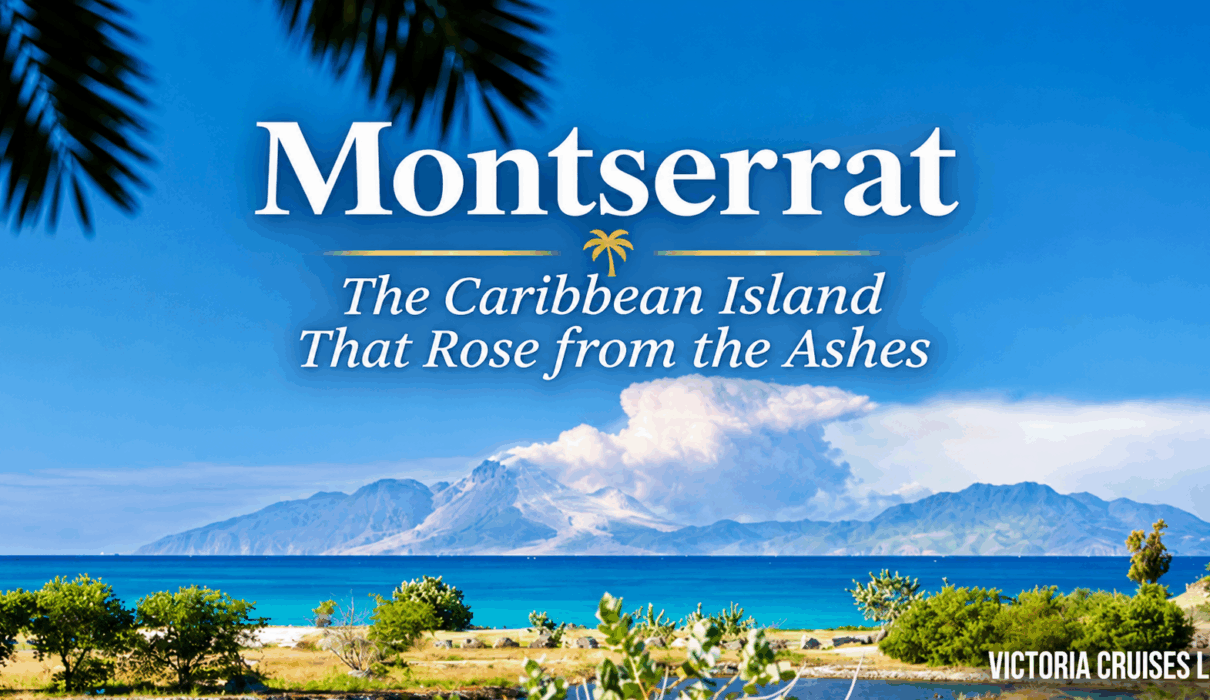
Discover the extraordinary story of Montserrat, where volcanic landscapes, a buried capital, Irish heritage, and Caribbean traditions reveal one of the region’s most fascinating islands.
The Caribbean’s Emerald Isle
Imagine a Caribbean island where emerald-green mountains rise above the sea, black volcanic beaches stretch along the coastline, and the ruins of an abandoned capital tell the story of a community forever changed by nature. Welcome to Montserrat.
Unlike the Caribbean’s better-known holiday destinations, Montserrat offers something wonderfully different. There are no sprawling resort districts or crowded tourist attractions. Instead, visitors discover dramatic landscapes, quiet villages, fascinating history, and a community whose resilience has become an essential part of the island’s identity.
Often called the Emerald Isle of the Caribbean, Montserrat is a British Overseas Territory in the Lesser Antilles, southwest of Antigua. Its nickname reflects both its lush green scenery and its remarkable Irish heritage. But beneath the island’s peaceful appearance lies one of the most extraordinary stories in modern Caribbean history.

A Caribbean Island with an Unexpected Irish Connection
Long before European settlers arrived, Montserrat was inhabited by Indigenous Caribbean peoples. Archaeological discoveries, including ancient petroglyphs, provide evidence of the island’s early inhabitants. The island was known as Alliouagana, a name associated with its Indigenous past. Christopher Columbus sighted the island in 1493 and named it after the famous monastery of Montserrat in Spain.
English settlement began in 1632, and Irish settlers became an important part of the island’s colonial history. Over the centuries, Montserrat developed a distinctive cultural identity shaped by Irish traditions, African heritage, Caribbean customs, and the experiences of generations who called the island home.
Enslaved Africans were brought to work on plantations, and their descendants profoundly shaped Montserrat’s language, music, food, and cultural traditions.
Today, the island’s Irish connection remains visible in place names, family names, cultural celebrations, and the green shamrock associated with Montserrat.
Yet its identity is much richer than any single influence. Montserrat is a place where different histories have come together to create something uniquely Caribbean.
Plymouth – The Caribbean City Buried by a Volcano
For much of its modern history, Plymouth was the bustling capital of Montserrat. Located on the island’s southwestern coast, it was the center of government, commerce, and everyday life.
Its streets were lined with shops, offices, homes, churches, and public buildings. Then, in July 1995, everything began to change. After centuries of relative quiet, the Soufrière Hills volcano awakened. What followed was not a single catastrophic explosion, but a prolonged period of volcanic activity that transformed the southern part of the island.
As the danger increased, residents were forced to evacuate their homes and businesses. Plymouth was evacuated, and volcanic eruptions, ash deposits, and destructive flows gradually overwhelmed the city. On June 25, 1997, a particularly devastating volcanic event claimed 19 lives. The disaster also triggered a profound social and economic crisis. Thousands of Montserratians left the island, many eventually settling in the United Kingdom and elsewhere in the Caribbean and North America.
Entire neighborhoods disappeared beneath layers of volcanic material. Buildings that once formed part of a thriving capital became silent reminders of a vanished world. Today, Plymouth is sometimes described as the Pompeii of the Caribbean. The comparison is understandable, although the stories of the two cities are separated by nearly two thousand years. In Plymouth, rooftops, damaged buildings, and remnants of streets remain visible in a landscape transformed by volcanic activity.
The city is haunting, but it is also deeply moving. It reminds visitors that the places we call home can change in ways we never imagine. Plymouth remains within a controlled volcanic exclusion zone. Visits require authorized arrangements with certified local guides and are subject to official safety restrictions.


Soufrière Hills – The Volcano That Changed an Island
The Soufrière Hills volcano dominates Montserrat’s modern history. Rising above the southern part of the island, it is a powerful reminder of the geological forces that created much of the Caribbean. Although the volcano has experienced no major eruptive episode since 2010, it remains active and is carefully monitored. The Montserrat Volcano Observatory plays an essential role in studying volcanic activity and providing information to protect residents and visitors.
For travelers, the observatory and designated viewpoints offer opportunities to learn about the island’s geology and understand the enormous impact of the eruptions. From safe observation areas, the landscape reveals a remarkable contrast. Green hills and tropical vegetation stand near volcanic valleys, ash-covered terrain, and the remnants of communities that once flourished in the south. The scenery is spectacular, but the experience is also educational. Montserrat demonstrates how closely human life can be connected to the natural forces beneath the Earth’s surface. Visitors should always follow official guidance and never enter restricted volcanic areas independently.
Little Bay – The New Heart of Montserrat
While the southern part of Montserrat was transformed by volcanic activity, the island’s northern communities became the center of its renewal. Little Bay developed into an important port and commercial area. Today, it welcomes visitors with a relaxed atmosphere, waterfront restaurants, and views of the Caribbean Sea. The surrounding area offers a glimpse of contemporary Montserrat: a small island community rebuilding its future while preserving its traditions. Little Bay is also a convenient starting point for exploring the island.
Nearby, the Montserrat National Museum introduces visitors to the island’s history, from its Indigenous past to the volcanic events that reshaped modern life. Brades, farther inland, serves as the island’s de facto administrative center, while Plymouth remains its official capital. This unusual arrangement reflects Montserrat’s extraordinary circumstances.
Black-Sand Beaches and Hidden Coastal Treasures
Montserrat’s beaches are unlike those found on many other Caribbean islands. Because of its volcanic origins, much of the coastline features striking dark sand. These beaches create a beautiful contrast between the deep blue sea, black volcanic shoreline, and green hills.
Woodlands Beach
Woodlands Beach is one of the island’s most scenic coastal locations. Its dark sand and relatively peaceful setting make it a wonderful place to appreciate Montserrat’s natural beauty. Depending on the season, sea turtles may also be associated with the island’s beaches, making coastal conservation particularly important.

Rendezvous Beach
For travelers dreaming of white sand, Rendezvous Beach offers a surprise. It is Montserrat’s only white-sand beach and can be reached by boat, kayak, or a hike. Its secluded setting makes it one of the island’s most appealing coastal escapes.
Little Bay Beach
Little Bay provides a more accessible seaside experience, with opportunities for swimming, snorkeling, kayaking, and enjoying the waterfront. For visitors arriving by sea, it is an inviting introduction to Montserrat’s relaxed Caribbean atmosphere. As always, sea conditions should be checked before swimming or undertaking water activities.
Runaway Ghaut – A Spring with a Caribbean Legend
Not every memorable attraction on Montserrat involves dramatic volcanic scenery. Runaway Ghaut offers a quieter experience. Surrounded by lush vegetation, this natural spring is one of the island’s best-known traditional stopping points. According to local legend, anyone who drinks from its water is destined to return to Montserrat. It is a charming story that captures the island’s warm and welcoming character. The surrounding greenery also offers a glimpse of Montserrat’s tropical environment, where nature has remained central to everyday life. Whether or not the legend proves true, Runaway Ghaut is a lovely place to pause and appreciate the island’s peaceful atmosphere.
St. Patrick’s Day – A Caribbean Celebration Unlike Any Other
One of Montserrat’s most fascinating cultural traditions is its celebration of St. Patrick’s Day. The island’s Irish heritage gives the festival a distinctive historical connection, but the celebrations also commemorate a much more complex chapter of Montserrat’s past. On March 17, 1768, enslaved Africans planned an uprising against plantation owners. The plot was discovered, and the date later became an important symbol of remembrance. Today, Montserrat’s St. Patrick’s Festival brings together Irish and African-Caribbean traditions. The festivities feature music, cultural performances, traditional dress, community events, and celebrations of the island’s history. Visitors may encounter everything from Caribbean rhythms to Irish-inspired festivities. What makes the festival particularly meaningful is the way it acknowledges different strands of Montserrat’s heritage. It is not simply a Caribbean version of an Irish holiday. It is an expression of the island’s own history, identity, and cultural resilience.

IThe Flavors of Montserrat – Caribbean Cuisine with a Local Soul
No journey through Montserrat would be complete without discovering its food. The island’s cuisine reflects the influence of African-Caribbean cooking traditions, local agriculture, seafood, and the wider history of the region. One dish stands above all others.
Goat Water – Montserrat’s National Dish
Despite its unusual name, Goat Water is a rich, deeply flavored goat-meat stew. Prepared with herbs, spices, and slow-cooked meat, it is one of Montserrat’s most recognizable culinary traditions. The dish is especially associated with community gatherings and celebrations, including the St. Patrick’s Festival. Every family and cook may have a slightly different version, making Goat Water as much a part of local identity as a recipe. For adventurous food lovers, it offers a wonderful introduction to authentic Montserratian cooking.
Fresh Seafood and Caribbean Flavors
Fresh fish and other seafood also play an important role in island cuisine. Depending on the season and availability, visitors may find grilled fish, lobster, and traditional Caribbean accompaniments. Rice and peas, plantains, vegetables, and locally prepared sauces contribute to the island’s culinary character. What makes the experience memorable is not elaborate presentation but the connection between food, community, and tradition. A simple meal overlooking the Caribbean Sea can become one of the most enjoyable memories of a visit..

Discovering Montserrat in One Day
For travelers visiting Montserrat as part of a Caribbean itinerary, a carefully planned day can reveal many of the island’s highlights. Begin in Little Bay, where the waterfront provides an introduction to the island’s present-day life. Visit the Montserrat National Museum to understand the island’s history before exploring the volcanic landscape. Continue toward a safe viewpoint overlooking the Soufrière Hills volcano, or arrange an appropriate visit to the Montserrat Volcano Observatory if access is available. A stop at Runaway Ghaut introduces one of the island’s best-loved local legends. For lunch, look for a restaurant serving Montserratian cuisine and, if available, try traditional Goat Water. Spend the afternoon enjoying the coastline, perhaps at Woodlands Beach or back in Little Bay. Travelers with a particular interest in volcanic history may wish to arrange an authorized tour of Plymouth instead of some of the other stops. Because entry to the exclusion zone is strictly controlled, these visits should be booked in advance and cannot be guaranteed. Montserrat rewards travelers who appreciate a slower pace and prefer meaningful experiences over crowded attractions. The island may be small, but its story is immense.
Montserrat – An Island of Resilience and New Beginnings
Montserrat is not simply another beautiful Caribbean destination. It is an island that has experienced extraordinary loss while continuing to preserve its identity, traditions, and sense of community. Its volcanic landscape tells a story of destruction, but its people tell a story of determination. The ruins of Plymouth remind us of what was lost. The communities of northern Montserrat show us what has been rebuilt. And the island’s music, food, celebrations, and natural beauty reveal a culture that continues to thrive. Perhaps that is what makes Montserrat so unforgettable. Beyond its green mountains and black-sand beaches, it offers something that cannot be captured in a photograph: the remarkable spirit of a place that refused to disappear.
At Victoria Cruises Line, we believe the most meaningful journeys are those that reveal the stories behind the destinations. Montserrat is a perfect example.
A small Caribbean island with an extraordinary history, a distinctive culture, and a powerful message about resilience.
Discover more destinations and travel stories with Victoria Cruises Line.