

Discover the capital of the Kingdom of Tonga, where centuries-old Polynesian traditions, royal heritage, spectacular ocean landscapes and warm island hospitality create an unforgettable South Pacific experience.
Far across the South Pacific, surrounded by turquoise waters and scattered coral islands, lies a kingdom unlike almost anywhere else in the world. Tonga is a place where ancient traditions remain part of everyday life, where royal ceremonies continue to hold deep cultural significance, and where the rhythm of the ocean shapes the lives of its people.
At the heart of this remarkable island nation is Nuku’alofa, the capital of the Kingdom of Tonga. Unlike the bustling metropolises of Asia or Europe, Nuku’alofa offers a more intimate experience. Its waterfront, colourful markets, historic churches and royal landmarks reveal a city where community and tradition remain central to daily life. Yet the true beauty of Nuku’alofa lies beyond its streets.
Across the island of Tongatapu, travellers discover mysterious ancient monuments, dramatic limestone coastlines, spectacular blowholes and small tropical islands that seem almost untouched by time. For those seeking an authentic introduction to Polynesian culture, Nuku’alofa is one of the South Pacific’s most fascinating destinations..

Welcome to the Kingdom of Tonga
Tonga is an archipelago of more than 170 islands spread across a vast area of the South Pacific Ocean. Its islands are divided into several main groups, including Tongatapu, Ha’apai, Vava’u, ʻEua and the remote Niuas. The capital, Nuku’alofa, is located on Tongatapu, the country’s main island and its political, economic and cultural centre.
The name Nuku’alofa is commonly translated as “Abode of Love,” a fitting introduction to a destination where hospitality and family relationships hold great importance. What makes Tonga particularly remarkable is its history. Unlike many Pacific island nations, Tonga preserved its Indigenous monarchy and was never formally annexed as a European colony.
Although the kingdom became a British protected state in 1900, it retained its own royal institutions and internal government. In 1970, the protectorate arrangement ended, and Tonga continued as an independent sovereign kingdom. Today, the country remains one of the world’s few surviving monarchies with deep roots in traditional Polynesian leadership.
Its royal heritage is not merely a historical attraction. It remains an essential part of Tongan national identity.
A Kingdom Shaped by the Ocean
Long before European explorers reached the South Pacific, Polynesian navigators were crossing enormous distances in ocean-going canoes. Guided by stars, winds, ocean currents and knowledge passed through generations, they established communities across the islands of the Pacific. Tonga became an important centre of regional political and maritime influence.
The Tuʻi Tonga dynasty, whose origins are traditionally associated with the first millennium CE, developed a powerful system of chiefly authority. Over time, Tongan influence extended beyond its own islands through political relationships, maritime exchange and, at times, military expansion. This rich history survives in archaeological monuments, oral traditions, ceremonial practices and the continuing importance of chiefly and royal institutions.
The modern Kingdom of Tonga took shape during the 19th century under King George Tupou I. In 1875, he introduced a constitution that helped establish the foundations of the modern Tongan state. Nuku’alofa became the kingdom’s capital, developing into the administrative and ceremonial heart of the nation.
For visitors, understanding this history adds a deeper meaning to the city’s royal landmarks and cultural traditions.

TIP: Nuku Alofa City Tour
TIP: East Coast Historical + Anahulu Cave and Anahulu Beach Tour
The Royal Palace: Tonga’s Most Recognisable Landmark
Standing beside the waterfront in Nuku’alofa is one of the city’s most photographed buildings: the Royal Palace. With its distinctive white exterior, red roof and elegant Victorian-style architecture, the palace presents a striking contrast to the surrounding tropical landscape. Completed in the 19th century, it has long been associated with Tonga’s royal family and remains an important symbol of the monarchy.
The building’s European architectural influences reflect the historical connections that developed between Tonga and the wider world during the 1800s. Yet its significance is distinctly Tongan. The palace represents the continuity of a royal institution that has remained central to the country’s history and identity. Visitors can admire the palace from outside its grounds, although public access to the residence is generally restricted. The surrounding waterfront provides an attractive setting for photographs, particularly when the afternoon light falls across the historic building. It is an ideal starting point for discovering Nuku’alofa. The Royal Tombs: A Sacred Connection to Tonga’s Past.
Another important landmark is the Malaʻekula Royal Tombs. Located in central Nuku’alofa, this sacred burial ground is associated with members of Tonga’s modern royal dynasty. The site reflects the deep respect traditionally shown to royal ancestors and the continuing significance of the monarchy. Unlike the elaborate royal mausoleums found in some parts of the world, the grounds possess a quiet dignity. Their significance lies in the history and cultural meaning they represent. Visitors should remember that this is a sacred site rather than an ordinary tourist attraction. Respectful behaviour and observation from permitted public areas are essential. For travellers interested in Tonga’s history, the Royal Tombs provide another perspective on the kingdom’s enduring traditions.

Talamahu Market: The Colourful Heart of Nuku’alofa
To experience the everyday life of the capital, few places are more rewarding than Talamahu Market. Located in the centre of Nuku’alofa, this lively market brings together farmers, artisans, traders and local families. The atmosphere is filled with conversation, colourful produce and the distinctive aromas of tropical fruits and freshly harvested vegetables. Visitors may encounter bananas, coconuts, taro, cassava, yams and other ingredients that form an important part of traditional Tongan cuisine. The market is also an excellent place to discover local handicrafts. Handwoven baskets, traditional mats, carved objects and decorative items reveal the skill and creativity of Tongan artisans. Particularly interesting are products connected with ngatu, the traditional Tongan barkcloth. Made from the inner bark of the paper mulberry tree, ngatu is decorated with distinctive patterns and plays an important role in ceremonies and gift-giving.
These traditional textiles are much more than decorative objects. They represent family connections, social relationships and cultural knowledge passed from one generation to another. For visitors, Talamahu Market offers an opportunity to discover the human side of Nuku’alofa. It is a place where the country’s traditions remain part of everyday life.
The Churches of Nuku’alofa: Faith and Community
Religion plays an important role in contemporary Tongan society. Christianity became deeply established during the 19th century, and churches remain central to community life throughout the islands. Nuku’alofa is home to several important religious buildings, including the Saione Centenary Church, associated with the Free Wesleyan Church of Tonga. Its architecture and historical significance make it one of the capital’s notable landmarks. Sunday church services are particularly memorable for their music. Tongan congregational singing is renowned for its rich harmonies and emotional depth.
For visitors who attend a service, the experience can offer a moving introduction to the importance of faith, family and community. However, Sunday is also widely observed as a day of rest. Many businesses close, and visitors should respect local customs, dress modestly and avoid treating religious services as tourist performances. The atmosphere of a Tongan Sunday reveals a distinctive aspect of the country’s cultural identity.
Ha’amonga ʻa Maui: The Stonehenge of the Pacific
One of Tonga’s most extraordinary historical monuments lies on the eastern side of Tongatapu. Known as Ha’amonga ʻa Maui, this impressive stone trilithon consists of two enormous upright limestone pillars supporting a horizontal stone lintel. The monument is often called the “Stonehenge of the Pacific” because of its unusual construction and mysterious appearance.
It is generally associated with the 13th century and the era of the Tuʻi Tonga rulers. The exact original purpose of the monument remains a subject of historical interpretation. Some explanations connect it with royal authority and ceremonial significance, while others have suggested astronomical functions. Local traditions also associate the monument with Maui, the legendary Polynesian figure whose stories appear across the Pacific.
According to legend, Maui’s extraordinary strength made it possible to move the massive stones. Although this belongs to mythology rather than established archaeology, it adds another fascinating dimension to the site. Standing beside Ha’amonga ʻa Maui, visitors encounter a powerful reminder of Tonga’s ancient civilisation and its remarkable achievements.

The Ancient Royal Tombs of Lapaha
Tongatapu’s historical treasures extend beyond Nuku’alofa itself. In the village of Lapaha, near the former royal centre of Muʻa, visitors can discover ancient royal burial structures known as langi. These monumental terraced tombs were constructed using carefully arranged stone blocks and coral limestone.
They are associated with Tonga’s traditional ruling dynasties and reflect the importance of royal authority in the islands’ early history. The scale of the structures is especially impressive when considering the methods available to their builders. Transporting and positioning enormous stone blocks required considerable organisation, technical knowledge and labour.
For travellers interested in archaeology, Lapaha provides a fascinating opportunity to explore the sophistication of ancient Polynesian societies. The monuments also reveal that Tonga’s historical significance extends far beyond its modern capital.
Mapu ʻa Vaea: Where the Pacific Ocean Explodes Against the Coast
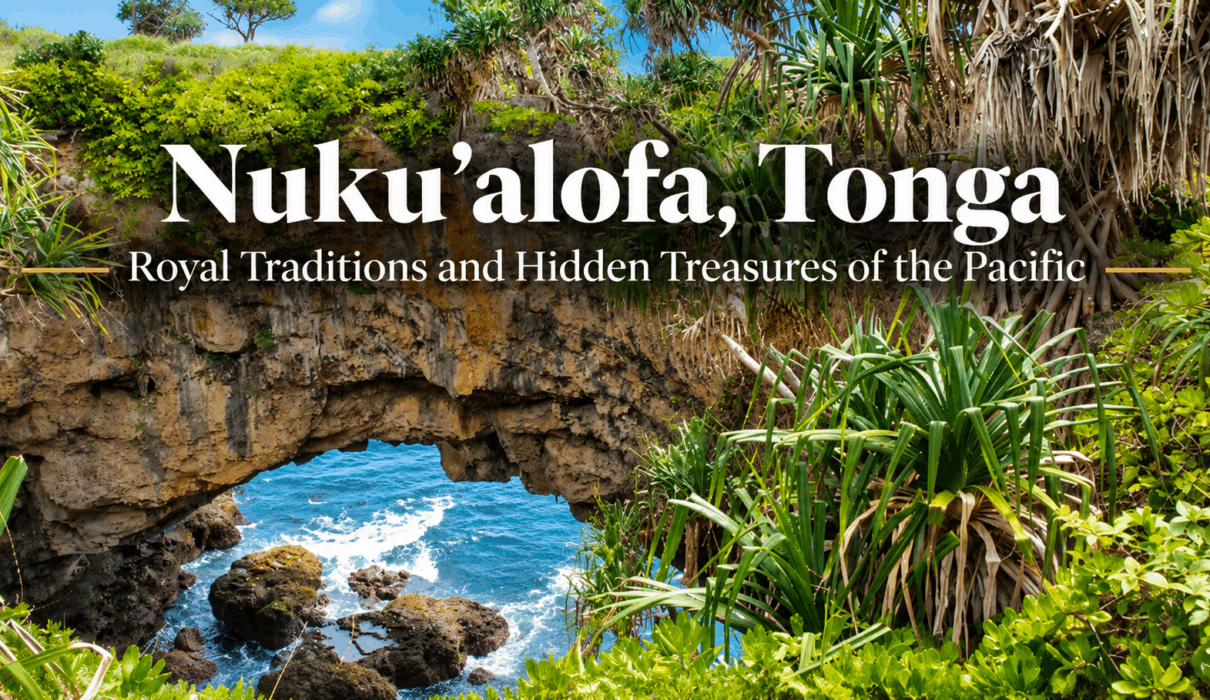
Tonga’s natural landscapes are just as remarkable as its history. On the southwestern coast of Tongatapu lies Mapu ʻa Vaea, one of the island’s most spectacular natural attractions. Here, powerful Pacific waves crash against the limestone coastline, forcing seawater through openings in the rock. The result is a dramatic series of blowholes that send columns of spray high into the air.
During periods of strong surf, the coastline becomes a breathtaking display of ocean energy. The sound of waves striking the rocks combines with the sight of water erupting through the natural formations. The name is often translated as “Vaea’s Whistles,” reflecting the distinctive sounds created by the rushing water.
The experience is particularly impressive when ocean conditions are favourable. Visitors should remain at a safe distance from the cliff edges and follow local guidance, as powerful waves and slippery rocks can make the area dangerous. Mapu ʻa Vaea is a reminder that the Pacific Ocean is both beautiful and extraordinarily powerful.
ʻAnahulu Cave: An Underground World of Natural Beauty
On the eastern side of Tongatapu, another remarkable natural attraction awaits visitors. ʻAnahulu Cave is a limestone cavern known for its dramatic rock formations and freshwater pools. Inside, stalactites hang from the ceiling while stalagmites rise from the cave floor. These formations developed gradually over immense periods as mineral-rich water passed through the limestone. The cave’s atmosphere is cool and mysterious, offering a striking contrast to the tropical landscape outside. One of its most unusual features is a freshwater pool within the cave system. Where access and conditions permit, visitors may have the opportunity to enjoy the water in designated areas. Local guidance is recommended, particularly because cave surfaces can be slippery and some sections are not suitable for casual exploration. ʻAnahulu Cave reveals another side of Tongatapu’s geological character.
Pangaimotu Island: A Tropical Escape Near the Capital
Just offshore from Nuku’alofa lies Pangaimotu, a small island that offers a very different atmosphere from the capital. Surrounded by clear tropical water and fringed with palms, the island has long been a popular destination for day excursions. Its appeal lies in its simplicity. Visitors can relax beside the sea, enjoy the island scenery or explore suitable swimming and snorkelling areas when conditions allow. The short journey across the water provides attractive views of the surrounding coastline and the harbour.
Pangaimotu is an excellent example of the island experiences that make Tonga so appealing. However, boat transfers and visitor facilities can change, so arrangements should be confirmed locally before departure. For travellers with additional time, it offers a peaceful complement to the historical and cultural attractions of Nuku’alofa.
The Flavours of Tonga: Discovering Traditional Polynesian Cuisine

TA visit to Tonga would not be complete without discovering its food traditions. Tongan cuisine is closely connected with the ocean, tropical agriculture and the importance of sharing meals with family and community. Fresh fish, coconut, root vegetables and leafy greens are common ingredients. Traditional preparation methods reflect generations of knowledge and the resources available throughout the islands.
ʻOta ʻIka: Fresh Fish with Coconut and Citrus
One of Tonga’s best-known dishes is ʻota ʻika. This refreshing speciality typically combines raw fish with citrus juice, coconut cream and vegetables. The result is a delicate balance of fresh seafood, creamy coconut and bright citrus flavours. Variations of raw fish dishes are found throughout the Pacific, but each island culture has developed its own traditions. In Tonga, ʻota ʻika is particularly enjoyable in the warm tropical climate. As with all raw seafood, visitors should choose reputable establishments that follow appropriate food-handling practices.
Lu Pulu: A Traditional Tongan Favourite
Another distinctive dish is lu pulu. It is traditionally prepared using beef, coconut cream and taro leaves, although recipes vary between families. The ingredients are wrapped and cooked until the meat becomes tender and the flavours blend together. Lu pulu is a rich and satisfying example of Tongan home cooking. Its combination of leafy greens, coconut and meat reflects the importance of locally available ingredients.
The ʻUmu: Cooking Beneath the Earth
One of the most fascinating elements of Tongan cuisine is the traditional earth oven known as the ʻumu. Food is arranged with heated stones and covered so that it cooks slowly using retained heat. Meat, fish and root vegetables may all be prepared using this method. The ʻumu is more than a cooking technique. It is associated with gatherings, celebrations and the shared preparation of meals. Experiencing a traditional Tongan feast offers visitors an opportunity to understand the relationship between food, hospitality and community life.
Tongan Culture: The Meaning of Respect and Hospitality
Tongan culture places great importance on family, community, respect and social relationships. Traditional values continue to influence ceremonies, celebrations and everyday interactions. One of the most important cultural concepts is fakaʻapaʻapa, commonly associated with respect. Respect for elders, family members, community leaders and established traditions is deeply embedded in Tongan social life. Another essential element is the concept of ʻofa, meaning love or affection.
These values help explain the importance of generosity, hospitality and maintaining strong family connections. Traditional dance, music, storytelling and ceremonial practices remain important expressions of Tongan identity. Visitors who attend a cultural performance may encounter dances such as the lakalaka, a highly significant Tongan performance tradition combining movement, poetry and music. Recognised internationally as an important element of intangible cultural heritage, lakalaka reflects the richness of Tonga’s artistic traditions. For travellers, experiencing these cultural expressions can be among the most memorable aspects of visiting the kingdom.
What to See in Nuku’alofa in One Day
Nuku’alofa and Tongatapu offer a rewarding combination of cultural and natural attractions. For visitors with just one day, the best approach is to choose a manageable itinerary rather than attempt to see everything.
Morning: Discover the Royal Capital
Begin with a walk along the waterfront to admire the Royal Palace. Continue toward the Malaʻekula Royal Tombs, observing the grounds respectfully from permitted public areas. Then visit Talamahu Market to experience the atmosphere of local life. Take time to browse the traditional crafts and discover the tropical produce sold by local vendors.
Lunch: Taste Traditional Tongan Food
Enjoy a meal at a local restaurant. Look for traditional specialities such as ʻota ʻika or dishes prepared with coconut cream and root vegetables. This is an excellent opportunity to experience the flavours of Polynesian cuisine.
Afternoon: Explore Tongatapu
For the afternoon, consider a guided excursion beyond the capital. History enthusiasts may prefer Ha’amonga ʻa Maui and the ancient royal tombs of Lapaha. Nature lovers may choose the spectacular Mapu ʻa Vaea blowholes or ʻAnahulu Cave. Because these attractions are spread across the island, travelling with a local driver or organised tour is often the most convenient option. A visit to Pangaimotu Island is another appealing possibility, but it is best treated as an alternative excursion rather than combined with a full island tour.
Practical Travel Tips for Visiting Tonga
Tonga has a warm tropical climate, with seasonal variations in rainfall and temperature. The generally cooler and drier months from May to October are often attractive for outdoor activities. The warmer, wetter season usually extends from November to April and overlaps with the South Pacific tropical cyclone season.
Visitors should check weather conditions and official travel information before planning excursions. The local currency is the Tongan paʻanga. Although payment cards may be accepted at some hotels and larger businesses, carrying local cash is useful for markets and smaller establishments. Tongan and English are official languages, making communication relatively straightforward for many international visitors.
Sunday observance is particularly important. Many shops, services and attractions operate on reduced schedules or close entirely, so travellers should plan accordingly. Modest clothing is appreciated, especially when visiting villages, churches and culturally significant locations. For coastal excursions, swimming and snorkelling, always follow local advice and pay attention to sea conditions.
Why Nuku’alofa Is One of the Pacific’s Most Fascinating Capitals
Nuku’alofa may not possess the skyscrapers of Singapore or the grand boulevards of European capitals. Its appeal is something entirely different. Here, royal heritage is woven into everyday life. Ancient monuments reveal the achievements of Polynesian civilisation. Markets preserve traditional crafts and food customs. Churches reflect the importance of faith and community. And beyond the city, dramatic coastlines, limestone caves and tropical islands reveal the extraordinary natural beauty of the South Pacific.
Tonga is a destination where history, culture and nature remain closely connected. For travellers seeking experiences beyond the familiar tourist routes, Nuku’alofa offers a remarkable introduction to one of the world’s most distinctive island kingdoms. It is a place that rewards curiosity, patience and an appreciation for traditions that have endured across centuries.
Discover the World with Victoria Cruises Line
Some destinations impress us with magnificent architecture. Others capture our imagination through spectacular landscapes. And then there are places like Nuku’alofa, where the greatest attraction is the opportunity to discover a different way of life. At Victoria Cruises Line, we believe that meaningful travel is about experiencing the world beyond its most famous landmarks.
Our adults-only residential cruising concept offers a lifestyle centred on discovery, cultural experiences and the freedom to explore extraordinary destinations around the globe. From the royal traditions of Tonga to the vibrant cities, historic ports and natural wonders of other continents, every journey offers new perspectives and unforgettable stories. Because travelling the world is not simply about collecting destinations. It is about understanding the remarkable diversity of the people, cultures and places that make our planet extraordinary.
Discover more about the Victoria Cruises Line residential cruising lifestyle at victoria.cruises.